Mgr Marcel Lefebvre Seminary
SAJM
The S.A.J.M.
(Society of the Apostles of Jesus and Mary)
The (Society of the Apostles of Jesus and Mary)
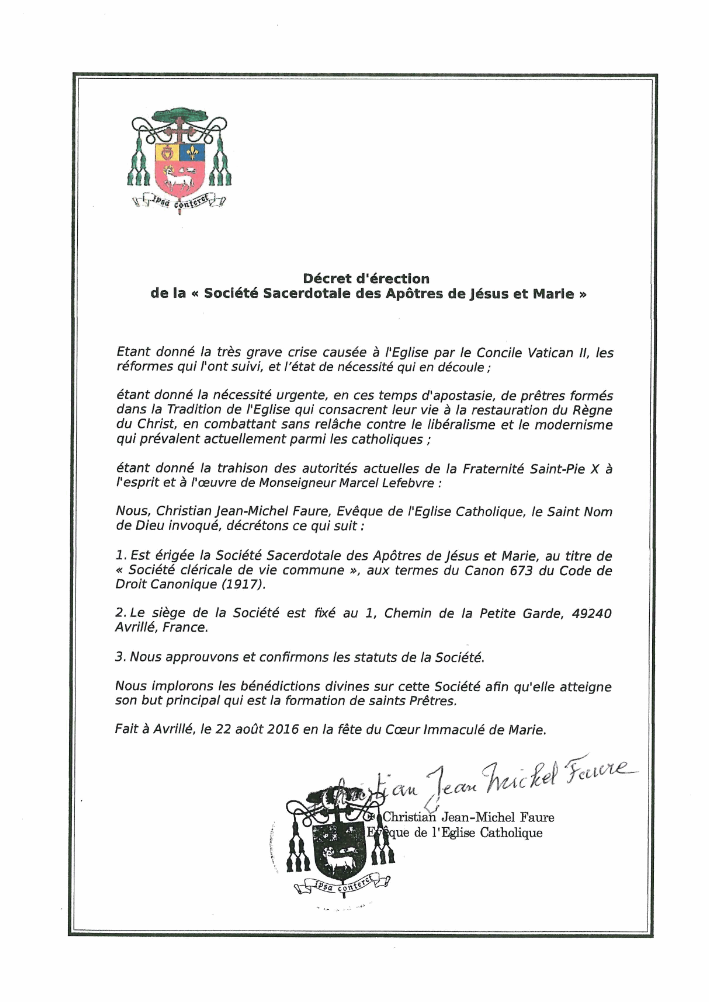
Decree of foundation of the “Priestly Society of the Apostles of Jesus and Mary”
Considering the extremely grave crisis caused in the Church by the Second Vatican Council, the reforms that followed it, and the state of necessity that results from it;
considering the urgent necessity, in these times of apostasy, for priests formed in the Tradition of the Church who dedicate their lives to the restoration of the Kingdom of Christ, fighting without respite against the liberalism and modernism that currently prevail among Catholics;
considering the betrayal of the current authorities of the Society of Saint Pius X with regard to the spirit and the work of Archbishop Marcel Lefebvre;
We, Christian Jean-Michel Faure, Bishop of the Catholic Church, invoking the Holy Name of God, decree the following:
The Priestly Society of the Apostles of Jesus and Mary is erected under the title of a “clerical society of common life,” according to Canon 673 of the Code of Canon Law (1917).
The seat of the Society is established at 1, Chemin de la Petite Garde, 49240 Avrillé, France.
We approve and confirm the statutes of the Society.
We implore the divine blessings upon this Society so that it may attain its principal end, which is the formation of holy priests.
Done at Avrillé, on 22 August 2016, on the feast of the Immaculate Heart of Mary.
✠ Christian Jean-Michel Faure
Bishop of the Catholic Church
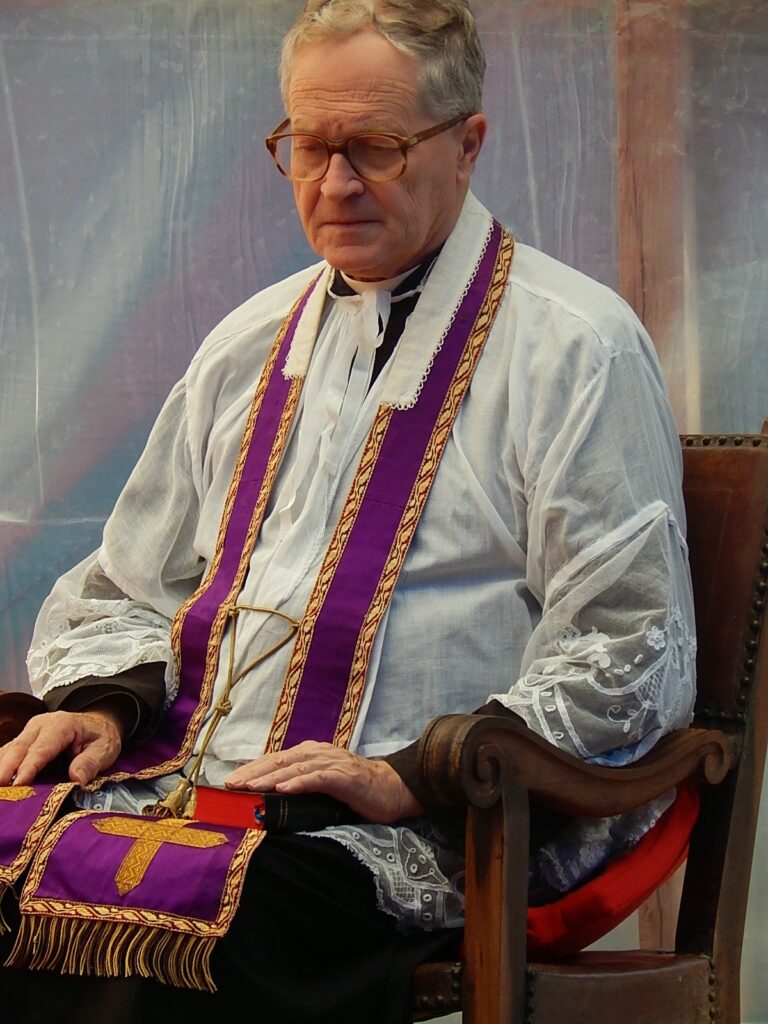
H.E.R. Mgr Jean-Michel Faure
In 1986, during a visit to Écône, Archbishop Marcel Lefebvre called Dom Jean-Michel Faure aside after a meal and asked him whether he would accept being consecrated a bishop. Later, he was in fact consecrated bishop by Bishop Richard Nelson Williamson in 2015.
Mgr Faure was one of the historic members of the Priestly Society of Saint Pius X, whose statutes — under the double title also of the Fraternity of the Apostles of Jesus and Mary — were approved on 1 November 1970 by Bishop François Charrière and officially praised on 18 February 1971 by the Sacred Congregation for the Clergy under Cardinal Wright. This double approval legally marked the work founded by Archbishop Lefebvre in the midst of what he himself described as the dismantling of the Catholic priesthood.
By founding the Society of the Apostles of Jesus and Mary (S.A.J.M.), Mgr Faure deliberately resumed that first historical name. His intention was to preserve in its entirety the principles established in the statutes of 1970: the formation of holy priests, fidelity to the faith in its integrity, and the traditional Mass, according to the spirit explicitly expressed by Archbishop Lefebvre. The name was not chosen by chance, but programmatically: to affirm continuity with the work originally erected in Fribourg, under the blessing of the diocesan authority and the Roman recognition of that time.
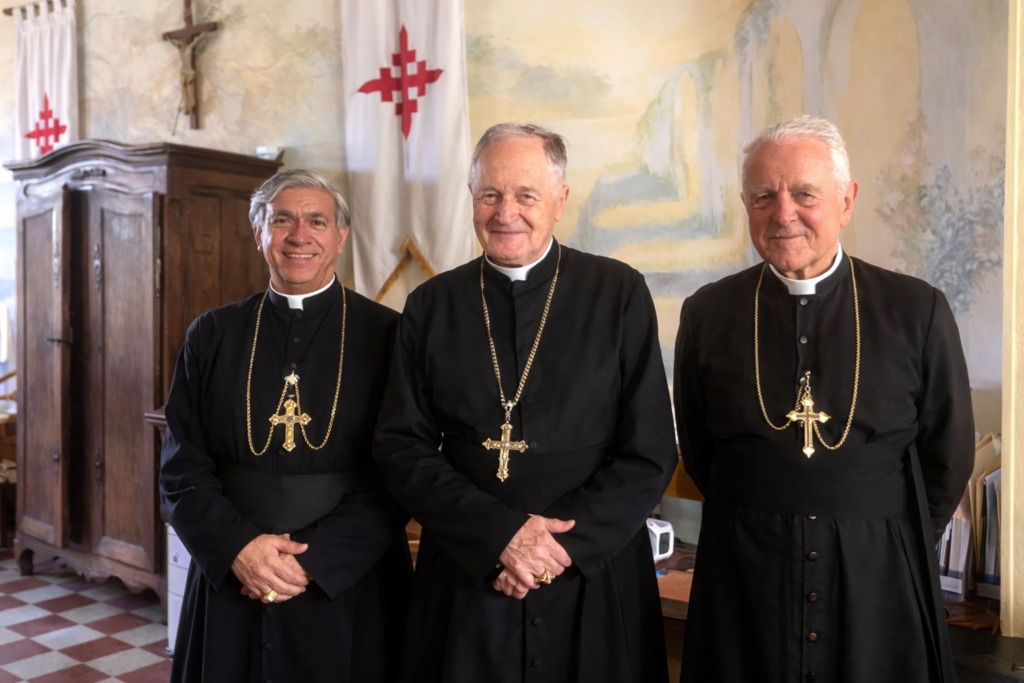
H.E.R. Mgr Gerardo Zendejas
Mgr Gerardo Zendejas was born in Mexico in 1963. He was formed at the Seminary of Our Lady Co-Redemptrix (FSSPX) in La Reja, Argentina. He was ordained subdeacon by Archbishop Marcel Lefebvre in 1986, deacon by Bishop Antônio de Castro Mayer in 1987, and priest on 10 December 1988 by Bishop Alfonso de Galarreta.
He exercised his ministry initially in Colombia, where he served as prior of Bogotá and founded a school with 320 students. Later he worked in Mexico and, beginning in 1998, in the United States, directing the FSSPX retreat house in Ridgefield, where he also founded a school in 2006 and promoted large pilgrimages to Auriesville.
In 2009 he became prior in Dickinson, Texas. After a 30-day Ignatian retreat in France, he joined the Resistance in 2014. A member of the Society of the Apostles of Jesus and Mary, founded by Mgr Jean-Michel Faure, he exercises his ministry mainly in Texas, Kansas, Connecticut and New York.
His episcopal consecration took place on 11 May 2017 at Saint Athanasius Church in Vienna, Virginia.
STATUTES OF THE SAJM
STATUTES OF THE PRIESTLY SOCIETY OF THE APOSTLES OF JESUS AND MARY
Preface
After several months of reflection, we are now in a position to promulgate the definitive statutes of the SAJM.
The statutes of the SAJM propose to preserve intact the spirit of the statutes given by Mgr Marcel Lefebvre to the FSSPX. Moreover, they aim to preserve their letter as far as possible while taking into account present circumstances.
Thus, certain articles of the statutes of the FSSPX which had become anachronistic were suppressed, for example those relating to a certain coordination with the diocesan clergy (Chap. III, no. 5; Chap. IV, nos. 1 and 2).
We likewise judged it necessary to add certain norms intended to protect the new congregation from the danger of deviation to one side or the other, such as the absolute prohibition of making an agreement with liberal and modernist Rome (Chap. II, no. 5) or the norms for the removal of the Superior General (Chap. V, no. 2). If similar provisions had existed in the statutes of the FSSPX, they might perhaps have prevented the Fraternity from becoming involved in the grave deviation of which we are witnesses today.
We have also added norms concerning the modification of the statutes (Chap. IX), which did not exist in the statutes of the FSSPX.
Finally, the statutes contain several transitional provisions, made necessary by the fact that this is a congregation in formation, which evidently cannot depend upon the Roman authorities, who strive to destroy the Church.
The Catholic Church is hierarchical and monarchical by divine institution. This will never change, whatever the depth of the crises through which history may pass. Thus, these two properties must be maintained in every truly Catholic congregation, without yielding to the temptation to weaken them out of fear that, by misusing them, Superiors might cause the congregation to deviate, as is currently happening in the FSSPX. It is not permitted to innovate in this field, much less in a liberal manner, which would consist in weakening the principle of authority.
May these statutes help the members to be faithful disciples of Jesus and Mary. In John XVII, 17, Our Lord addresses the Father concerning His disciples: “Sanctify them in the Truth. Thy word is Truth.” He also teaches us that charity proceeds from the knowledge of the true Faith: eternal, supernatural life already begins on this earth through the knowledge of the Father and of the Son — the work of the Holy Ghost — which makes divine life present in the souls of those who believe and thus become “partakers of the divine nature” (II Pet. I, 4).
“Go therefore, teach all nations” (Mt. XXVIII, 19)
✠ Christian Jean Michel Faure
Avrillé, 21 November 2017, on the feast of the Presentation of the Blessed Virgin Mary.
STATUTES OF THE PRIESTLY SOCIETY OF THE APOSTLES OF JESUS AND MARY
The text is based on the statutes of the FSSPX, Christmas 1976 version, expanded by the General Chapter of September 1982.
I — OF THE DEDICATION OF THE SOCIETY
1 — The Priestly Society of the Apostles of Jesus and Mary is a priestly society of common life without vows, similar to the societies of the Foreign Missions. Nevertheless, it is constituted in a spirit of profound faith and of perfect obedience, in imitation of the divine Master.
2 — The Society is essentially apostolic, because the Sacrifice of the Mass also is so and because its members will generally exercise an external ministry. They will live in the conviction that all the efficacy of their apostolate proceeds from the Sacrifice of Our Lord which they offer daily.
3 — The Society is placed especially under the patronage of Jesus the Priest, whose whole existence was and remains priestly, and for whom the Sacrifice of the Cross was the reason for His Incarnation. Thus the members of the Society, for whom “Mihi vivere Christus est” is a reality, live entirely oriented toward the sacrifice of the Mass, which prolongs the holy Passion of Our Lord.
4 — It is also under the aegis of Mary, Mother of the Priest par excellence and, through Him, Mother of all priests, in whom She forms her Son. She reveals to them the profound motives of her virginity, the condition for the flourishing of their priesthood.
II — OF THE END OF THE SOCIETY
1 — The end of the Society is the priesthood and all that pertains to it, and nothing beyond what pertains to it, as Our Lord Jesus Christ willed when He said: “Do this in memory of Me.”
2 — To orient and to realise the life of the priest toward that which essentially constitutes his reason for being: the holy Sacrifice of the Mass, with all that it signifies, all that proceeds from it and all that completes it.
3 — The members of the Society shall have a true and continual devotion to the Holy Mass, to the liturgy that crowns it, and to everything that can render the liturgy an expression of the mystery accomplished therein. They shall take care to prepare spiritually and materially for the holy Mysteries. A profound theological knowledge of the Sacrifice of the Mass will increasingly convince them that in this sublime reality the whole of Revelation is realised: the mystery of the Faith, the consummation of the mysteries of the Incarnation and of the Redemption, and the entire efficacy of the apostolate.
4 — Non-priest members and affiliated religious, when God raises them up, shall take charge of the care of the places and objects used in the liturgy. They will contribute to the splendour of the liturgy by means of music, chant, and everything that can legitimately help elevate souls to heavenly realities, to the Most Holy Trinity, in the company of the Angels and the Saints.
5 — Since the Second Vatican Council, the Holy Sacrifice of the Mass, Catholic doctrine, and the whole life of the Church have been attacked by the liberal and modernist hierarchy. Because the Catholic priesthood has the essential duty of combating liberalism and modernism in the defence of violated divine rights, the Society excludes every possibility of canonical regularisation through bilateral agreement, unilateral recognition, or by any other means whatsoever, so long as the Catholic hierarchy does not return to the Tradition of the Church.
III — OF THE WORKS OF THE SOCIETY
1 — All works of priestly formation and everything related to them, whether the aspirants intend to become members of the Society or not. Care shall be taken that formation reaches its principal goal: the sanctity of the priest, together with sufficient learning. Nothing shall be neglected so that piety may proceed from the liturgy of the holy Sacrifice of the Mass, the heart of theology, of pastoral life, and of the life of the Church.
For this purpose, it is desirable that the community of the Seminary be attached to a parish or to a place of pilgrimage, so that seminarians may gradually exercise themselves in the fulfilment of priestly functions under the direction of experienced and zealous members of the Society.
In conformity with the renewed desires and prescriptions of the Popes and Councils, the Summa Theologica of Saint Thomas Aquinas and its philosophical principles shall be the principal object of study in the Seminary. In this way, seminarians will carefully avoid modern errors, particularly liberalism and its offshoots.
2 — A second objective of the Society is to assist in the sanctification of priests by offering them the possibility of retreats and recollections. The houses of the Society may serve as centres for priestly associations, third orders, periodicals, or reviews intended for the sanctification of priests.
3 — The Society will strive to instil the greatness and the nobility of auxiliary vocations for the service of the altar and of all that is related to it: participation in the liturgy, in the Sacraments, in the teaching of the catechism, and in everything that may assist the priest and his parish ministry, in the service of presbyteries and seminaries.
4 — Schools that are truly free in order to provide fully Christian education to youth shall be encouraged and, when possible, founded by the members of the Society. From them will arise vocations and Christian homes.
5 — The Society will readily come to the assistance of elderly and sick priests, and even of the infidels.
IV — OF THE DIFFERENT WAYS OF BELONGING TO THE SOCIETY
1 — Although it is essentially clerical, the Society also willingly receives non-clerical aspirants, who possess their own statutes and pronounce religious vows.
2 — The Society likewise receives associates, priests or laymen, who wish to collaborate in the end of the Society and benefit from its graces for their own sanctification. After a minimum experience of two years in a house of the Society, these persons may subscribe to a commitment — a kind of contract — with the District Superior or with the Superior of the Seminary, in which the conditions of their admission are specified. They retain the disposal of their goods but commit themselves to conform to the spirit of the Society in the use they make of them.
3 — Entry into the Society is made, for clerics, by means of the commitment to remain faithful to the statutes, pronounced publicly before the Superior General or his delegate and before the Blessed Sacrament. This commitment may take place only after one year of preparation in a house of the Society.
4 — Clerics, during the years of formation up to the subdiaconate, will make annual commitments. From the subdiaconate onward, they may make commitments for three years and, after renewal for another three years, may assume the definitive commitment.
Priests who make their commitment in the Society must assume at least one triennial commitment before the definitive commitment.
The Brothers, according to their own statutes, after three years of annual vows and another six years of annual or triennial vows, will pronounce their perpetual vows.
5 — All members renew their commitments annually on 8 December, the feast of the Immaculate Conception. Those who renew them according to the statutory prescriptions, and those who do so out of devotion, recite only the act of oblation; only the former sign the records.
On that day of blessing, all members — priests or future priests — ask the faithful Virgin for the grace of fidelity to the commitments undertaken and for the grace of perfect unity in charity for the whole Society.
V — OF THE ADMINISTRATION OF THE SOCIETY
[Transitional norms: a) The first Superior General will be H.E. Mgr Jean Michel Faure, founder of the Society. He will exercise this function for as long as he judges it convenient. As long as the Society has fewer than fifty priest members, the subsequent Superiors General will be designated by Mgr Faure or, in his absence, by the absolute majority of the former Superiors General. b) The function of Assistants to the Superior General will be created when the Society has fifty or more priest members.]
1 — Of the offices whose holders are elected.
The Superior General and his two Assistants are elected by the General Chapter for four years. They may be re-elected.
The Superior General must be elected by two-thirds of the votes; the Assistants by absolute majority. All three must have assumed the definitive commitment in the Society, be priests, and be at least forty years of age.
2 — Supreme Council
There shall be a Supreme Council (SC) composed of three clerical members who, as far as possible, should be members of the Society.
After the government of Mgr Christian Jean-Michel Faure, this Council, by majority vote, may depose the Superior General who diverts the Society toward liberal positions or incurs in any other conduct that makes such a measure necessary.
The decree of deposition may not be the object of appeal or of any other recourse. At the moment of the deposition, an interim Superior General shall be designated, and this designation may fall upon a member of the SC itself. The decree of deposition and the designation of the interim Superior General must appear in a document dated and signed by the majority of the SC.
Within one month, the interim Superior General must convoke a General Chapter in order to elect the new Superior General. This Chapter must take place within three months from the date of the deposition.
The Councillors are irremovable. The first three members of the Council shall be designated by Mgr Faure. Each Councillor shall designate his successor by means of a document signed by the Councillor himself and by three witnesses duly identified by name and surname, date and place of birth, nationality, domicile, and passport number or identity document; or by means of written communication addressed to the other two Councillors.
When a member of the Supreme Council designates his successor, he shall inform the other two Councillors as soon as possible. If a Councillor dies without having designated his successor, this successor shall be designated by the other two members of the Council. If two Councillors die without having designated their successors, these shall be designated by the surviving Councillor.
What is established regarding death applies equally to other cases of vacancy, such as non-acceptance, resignation, permanent incapacity, etc.
If one of the Councillors assumes the office of Superior General, the other two Councillors shall designate his substitute. Upon leaving the office of Superior General — except in the case of having been deposed by the SC — the former Superior General shall ipso facto return to being a Councillor, and the one who replaced him shall cease to be so.
If two Councillors designate the same cleric as successor, he must designate another Councillor as soon as possible.
3 — Of the General Chapter
It meets every four years in order to elect the Superior General and his Assistants. Its purpose is also to verify whether the Society conscientiously applies the statutes and strives to preserve their spirit. Updates or innovations are to be avoided, except eventually in what concerns administration, taking into account the development of the Society.
4 — Of the members of the General Chapter.
– The outgoing Superior General, the General Secretary and the General Bursar;
– the District Superiors;
– the Seminary Superiors;
– the Superiors of autonomous houses;
– the bishops serving the Society;
– the former Superiors General;
– and then the most senior members of the Society who have made their definitive commitment (in case of equality, the elder), up to the limit of forty members while the Society has fewer than one thousand priest members.
5 — Of the offices whose holders are appointed by the Superior General after consulting his Assistants gathered in council
– General Secretary and General Bursar, for three years;
– District Superior, for three years;
– Superior of the major Seminary;
– Superior of an autonomous house;
– Professors, after consultation with the Superior;
– Director of the year of spirituality;
– Master of the novice Brothers.
By the District Superiors:
– District Assistant, district bursar, and local Superiors, with the approval of the Superior General;
– other offices.
6 — Of the Superior General and his Assistants
The General Council is composed of the Superior General and his two Assistants.
The Superior General governs and administers the Society. He consults his Assistants for important decisions.
The Assistants are the counsellors of the Superior General; they have deliberative vote in the most important matters.
The first Assistant is the Vicar General of the Superior General, that is, he replaces him in case of impediment or vacancy.
[Transitional norm: while there are no Assistants, the General Secretary will be the Vicar General of the Superior General.]
The General Council may have recourse to visitors of the different districts.
The General Council will convoke meetings of the District Superiors, of the Seminary Superiors, of the autonomous houses, and will call any other meeting useful for the good of the Society.
The Superior General and his two Assistants will do everything they judge useful in order to preserve, maintain, and increase in the hearts of all who hold offices and of all the members of the Society great generosity, a profound spirit of faith, and ardent zeal for the service of the Church and of souls.
For this purpose, they will organise and direct retreats and meetings that help the Society not to fall into tepidity nor into compromises with the spirit of the world. In their attitude and in their daily life, they will manifest the example of priestly virtues.
They will favour the preservation of a living and enlightened faith by establishing libraries well provided with the documents of the Magisterium of the Church and by publishing reviews or periodicals capable of helping the faithful to strengthen and defend their Catholic faith.
These directives apply also, mutatis mutandis, to all Superiors and especially to the District Superiors.
7 — Of the General Secretary
The General Secretary is responsible for preparing and drafting the minutes of the meetings of the General Council.
He communicates to the interested parties the decisions taken, after having submitted them to the signature of the Superior General.
He is responsible for the preservation of the archives and the individual files of the members. It is also his duty to remind them of the need to renew their commitments. He does this through the District Superior or his secretary. He takes care to keep the records of ordinations up to date.
8 — Of the General Bursar
The General Bursar ensures that the juridical situation of the associations of the Society in the various countries is regular. Where districts have been constituted, he verifies this situation with the Superior or with the district bursar.
Before the constitution of a district, he prepares and supervises the associations together with the responsible members. He ensures the legality of acquisitions in those regions and the proper administration of funds and legacies.
He administers the funds of the Society and the immovable properties that belong to it outside the districts. These funds are constituted by the surpluses of regions not yet constituted into districts, as well as by donations and legacies directed directly to the Society. He verifies the accounting of the districts.
Therefore, his functions are:
– to administer and control the associations and funds of the Society outside the districts;
– to verify the associations and accounts of the districts in this regard and to render account to the Superior General and to his Council;
– he has no power of decision;
– he is consulted for the appointment of district bursars;
– he strives to establish a simple and uniform accounting system for all districts, as well as for priories;
– he watches over insurance matters of every kind;
– in all his relations with those responsible in the Society, he strives to instil in them simultaneously the spirit of penance, of poverty, and also of prudence.
9 — Of the Seminary Superiors and of the statute of the Seminaries
Since priestly formation is the first and principal objective of the Priestly Society, the responsibility for this formation rests прежде all upon the Superior General and his Council.
He, assisted by his Council, appoints the Seminary Superiors and the professors ad nutum. It also belongs to him to watch, either personally or through his delegates, over the proper functioning of the Seminaries. He provides the Seminary Superiors with the various regulations that facilitate their task.
Thus, the Seminary Superiors have a great and noble function to fulfil before God, before Our Lord, and before the Church, for the glory of God and the good of souls. It is the only visible function that Our Lord wished to exercise outwardly during the three years of His public life. At the same time as they carry out the formation of priests, they must also think about the formation of future professors.
— Admission of seminarians
They receive the applications for admission of seminarians through the District Superiors, who submit the dossiers and present their opinion. It is desirable that candidates make a brief stay in the Seminary.
After the examination and the opinion of his collaborators, the Seminary Superior decides the admission, the refusal, or the postponement of acceptance. Candidates must not be older than 35 years.
— Dependence during formation
During the years of formation, seminarians depend constantly and in the first place upon the Seminary Superior. However, regarding holidays, he will come to an understanding with the District Superiors so that they may be used profitably, according to the regulations of the Seminary. The Seminary Superior is also the final authority and the one who decides.
— Extension or dismissal
The Superior, after consulting the opinion of his collaborators, decides the extension of studies or the dismissal of seminarians. He communicates this to the District Superior and reaches an agreement with him in order to facilitate, if necessary, the return to the lay state.
— Seminaries all international
The Seminaries shall all be considered international, since it is desirable that seminarians of other nationalities be received in them, provided they do not have difficulties with the language. In the case of a candidate for whom there already exists a Seminary in his own language, the authorisation of the District Superior will be necessary, who will consult the opinion of the Superior General.
— The District Superiors and the Seminaries
The District Superiors, who will be the first beneficiaries of the formation of young priests, must have great interest in their recruitment and formation. They will ensure that the faithful take interest in this essential work by means of continual prayers, by the ceremonies of first Masses, and by speaking about it in their bulletins.
— Pensions
They will also be responsible for finding benefactors to cover the cost of the pension for those who cannot pay it.
When it becomes necessary to build or expand the Seminary located in their district or the one that forms their priests, they will strive to assist the Superior General and the Seminary Superior in carrying out these works.
— Visits to seminarians
District Superiors may certainly take interest in their seminarians and visit them. However, they must avoid anything that could make the task of the Seminary Superior more difficult; on the contrary, they must do everything to facilitate it.
They must remember that the Church has never preferred number to quality.
— Pastoral assistance of the Seminary to the district
Seminary Superiors, for their part, will avoid everything that might hinder the District Superior. On the contrary, as far as possible, they will readily offer their services and those of the priest-professors to assist the pastoral work of the district, it being clearly understood that this pastoral activity depends first of all on the District Superior.
They will avoid making appeals to the generosity of the faithful without the authorization of the District Superior. The District Superior also decides the collections that will be carried out and their destination and, consequently, also the collections for the Seminary.
However, the Seminary will evidently have an account into which benefactors who wish may deposit their offerings. In these delicate matters, the Superiors should show themselves disinterested and generous on both sides, so that the charity so desirable may reign among those who are servants of the same Lord, Our Lord Jesus Christ.
10 — Of the District Superior
— He is appointed by the Superior General in his council for three renewable years. The limits of his district are then indicated to him.
— It is evident that this office is one of the most important; it is similar to what provincials exercise over their province. An entire region is entrusted to his apostolate. He must put into action the talents and the zeal of his collaborators in order to accomplish the task of the Priestly Society.
— Therefore, he is responsible before the Superior General for the wise pastoral, spiritual, and temporal administration of his district. As soon as possible, he will be assisted by two assistants and by a district bursar, whose name he presents to the Superior General for appointment, after the opinion of the General Bursar has been heard.
— He presents to the approval of the Superior General the names of the Priory Superiors and afterwards appoints their assistants himself. He also assigns the functions of the Brothers entrusted to him.
— He prepares the dossiers of aspirants to the priesthood and submits them to the Seminary Superiors, who decide on their acceptance.
— Little by little he organises the foundation of priories and houses for spiritual exercises. He ensures the good pastoral, spiritual, and temporal organisation of the communities according to the statutes and the spirit of the Priestly Society.
— However, for the foundation or the closure of a priory, he must request the authorization of the Superior General.
— He strives to establish communities of at least three members or associates of the Society.
— He also organizes the establishment of communities of religious of the Society together with the Superiors of the priories and with the agreement of the Mother General.
— He supervises all bulletins and all publications produced in his district. He grants authorizations, with prudence and discretion, for interviews with the press, radio, or television. All relations with civil authorities must pass through his intermediary, as well as those with ecclesiastical authorities.
— He authorizes the opening of accounts and bank deposits for the funds of the priories and of the district. For an expenditure exceeding 30,000 Swiss francs, he must obtain the authorization of the Superior General.
— He watches over the spiritual and bodily health of his collaborators and, in agreement with the Seminary Superior, takes charge of the holidays of the seminarians and, if he judges it necessary, presents a report on this matter to the Seminary Superior.
— He organizes spiritual exercises for the priests, Brothers, and associates of his district.
The Superiors of autonomous houses, which are districts in formation, are assimilated to the District Superiors.
11 — Of the Superiors and particularly of the local Superiors
As a complement to what has been said above, certain special directives will help the local Superiors to fulfil their function well, which is essential for the efficacy of the apostolate and for the good spirit of the Society.
One of their principal concerns must consist in the good order of the community, facilitating the apostolic work carried out by it. For this purpose, they will ensure that the schedules of the common exercises are known to all through posted notices and by a signal that alerts the members — Fathers, Brothers, and associates. The prayers of the community are carried out in common, even if only two members are present.
The Superiors ensure that the places of the community — especially the chapel, but also the refectory, the meeting and recreation room, and the library — are clean and sufficiently organized. If they are responsible for the bursary, they will watch over the hygiene of the food and of the kitchen.
They distribute duties both within and outside the community. They take care to direct and facilitate the work of the Brothers and of the employees of the house.
They will strive to assist in the sanctification of the Brothers and of the employees of the house. It is in the true liturgy and in common prayer that the unity and charity of the community will be forged.
Local Superiors will also give special attention to priestly, Brother, and religious vocations. They are likewise responsible for the chaplaincies of the religious of the Society, should there be a community within the territory of the priory.
Above all, it belongs to them to demonstrate the providential character of the foundation of the Society by the supernatural radiance of their serenity, by strength in joy, by total confidence in Our Lord and in His Most Holy Mother, by definitive adherence to the Roman Church and to the Successor of Peter insofar as he acts as the true Successor of Peter, and by respect for the bishops faithful to the grace of their consecration.
They will have an unlimited devotion to the Reign of Our Lord, according to the measure of the infinity of His Kingdom over persons, families, and societies. If they must manifest a political position, it will always be in the sense of this social Kingship of Our Lord Jesus Christ.
They will spread this devotion through the true Sacrifice of the Mass and through devotion to the Sacrament of the Eucharist, as well as through devotion to the Most Blessed Virgin Mary.
VI — OF THE VIRTUES OF THE MEMBERS
(This chapter indicates only the essential orientations. A more developed spiritual and pastoral directory will be drawn up for the members of the Society.)
1 — A great love for God, for the Most Holy Trinity, will inflame the hearts of the members of the Society. This charity must be such that it naturally engenders virginity and poverty, and constantly awakens the gift of self through faith and through prompt, generous, and loving obedience.
2 — This charity will arouse hunger and thirst for the virtue of justice, giving first of all to God what is due to Him through the virtue of religion. The interior dispositions of devotion, adoration, and prayer will help them to accomplish with the greatest perfection the most sublime act of Christian prayer: the holy Sacrifice of the Mass.
3 — Charity toward Jesus in the Eucharist and toward His Most Holy Mother, always present in His Offering, will incite the members of the Society to an ardent devotion to the Eucharist and to the Virgin Mary, in her compassion with Jesus, Priest and Victim, for the redemption of our sins.
4 — Nourished by this constant interior prayer, charity toward neighbour will manifest itself in the entire apostolic life of the members of the Society. Eager with the desire to save souls, they will accept with joy all contradictions, humiliations, and trials, in following Our Lord. Like Him, they will win souls by humility, by gentleness, by discretion, and by magnanimity. In the fulfilment of apostolic works, they will strive to be docile instruments of the Holy Ghost in order to transmit to souls eternal life.
5 — This charity toward neighbour will manifest itself above all in relation to the Superiors, through generous submission and constant respect; and in relation to the members of the community, through a spontaneous spirit of service, through forgetfulness of self, through great simplicity and frankness, through an always balanced humour and a communicative joy, and finally and above all through the desire for the sanctification of all and of each one.
6 — The virtue of religion and detachment from this world are also expressed in the exterior aspect. The habit of the members of the Society is the cassock. The cassock is testimony and preaching; it drives away evil spirits and those who are subject to them, and it attracts upright and generous souls. It greatly facilitates the apostolate. The Superiors judge the use of the black clerical suit with Roman collar (clergyman) acceptable in countries where it has long been customary, as in the Anglo-Saxon countries. The more impurity and the concupiscence of the flesh invade society, the more necessary the presence of the cassock becomes.
7 — Poverty, which is the immediate effect of the virtue of charity, strongly urges one to free oneself from every expense or every useless object. For this reason, the members of the Society will avoid acquiring the habit of smoking, which becomes a slavery. They will strive to break with the habits of the world, which has become enslaved to the radio, to television, to holidays and costly recreations. For this reason, there will be no television set in our communities.
A few carefully chosen newspapers and a selection of magazines will inform us sufficiently about events that it is useful to know. Our true television is the tabernacle, where He resides who puts us in communication with all spiritual and temporal realities.
They will show moderation in the choice of the vehicles that may be necessary for their function or for their apostolate.
VII — OF THE ORDINARY MEANS OF SANCTIFICATION OF THE MEMBERS
1 — In order to grow daily in these virtues, in union with God and in submission to the spirit of Our Lord, the members will strive never to omit the celebration of, or attendance at, the holy Sacrifice of the Mass, except in case of force majeure. They will consider it a privileged grace to serve the holy Mass.
2 — In the communities there will ordinarily be four moments of common prayer: the first is in the morning, which includes the recitation of Prime (or of Lauds on Sundays and holy days of obligation), mental prayer, the holy Mass, and thanksgiving. The priests, adding the necessary time, will be able to recite usefully part of their Breviary during this first moment.
3 — The second moment of prayer will take place, as far as possible, before lunch: during it the hour of Sext will be recited. The third moment will take place, as far as possible, before supper, and will include the rosary and the prayers to Saint Michael the Archangel and to Saint Joseph. At the beginning of this half-hour of prayer, benefactors and particular intentions will be recommended.
4 — The fourth moment will be that of Compline, after supper, sung if possible, or at least recited in psalmody. At that moment a free prayer is recommended, always in the presence of the Most Blessed Sacrament. Compline may take place immediately after supper or after a recreation, but never before supper. Recreation must never take place after this night prayer, after which silence should be observed with greater care.
5 — The Superiors will take care frequently to expose the Most Blessed Sacrament during the third moment of prayer or at other opportune times, in order to offer the community the occasion to adore the Most Blessed Sacrament.
6 — It must be remembered that nothing edifies the faithful so much as the example of the prayer of priests. For this reason, it is strongly recommended that prayers be made in the church. If there is a meeting in the afternoon, it will take place before or after Compline, and the participants will be invited to this prayer of the community.
7 — Confession will take place every fifteen days. Great esteem will be shown for this sacrament, both for oneself and for the faithful. Priests will spend their lives in the confessional. It is there that the efficacy of the Sacrifice of the Cross is particularly realised, according to the words of Our Lord: “Nunc judicium est mundi, nunc princeps hujus mundi ejicietur foras” (Jn XII, 31). The pastoral care of the sacrament of penance is of capital importance for the sanctification of a parish and for the awakening of vocations.
8 — The annual retreat of six days must be an organised retreat and not an individual one. The choice of the preachers and of the places must be the object of particular care. The atmosphere of silence, of true liturgical worship, and the firmness of the faith and doctrine of the preacher will help to bring about a true interior renewal.
VIII — OF THE PARTICULAR MEANS OF SANCTIFICATION OF THE MEMBERS
1 — Before becoming members of the Society, aspirants must complete a scholastic year of spirituality, during which they will strive to give Our Lord the place that belongs to Him in their souls and in their whole person.
For this purpose, they will fill their intellect with the light of Our Lord through meditative reading of the Gospel, of the Fathers, and of spiritual authors. The liturgy, Gregorian chant, sacred music, and Latin will also be objects of their studies.
However, this year must above all have as its goal a true conversion, a restoration of order through the abandonment of bad habits and the acquisition of natural and supernatural virtues, thanks to vigilance and prayer.
The mystical and theological knowledge of the holy Mass will increase their devotion to these holy Mysteries and to the Virgin Mary, Co-redemptrix and Mediatrix.
2 — The use of time and studies may present a certain diversity according to whether the aspirants are already priests or not, or whether they are destined for the priesthood or not.
3 — In the principal house, or in another designated for this purpose, there will exist a community of a more contemplative character, dedicated to the celebration of the holy Mass, to the adoration of the Most Blessed Sacrament, to the preaching of retreats on the premises, and to the hearing of confessions.
Some members, with the approval of the Superior General, may be assigned to this community in a definitive manner. All those who desire it may, with the same authorization, spend one or two years in this community in order to increase their sanctification and fervour.
This community must be the solid foundation and the lightning rod of the Society. It must allow the Society always to preserve its true end, which is the sanctification of the priesthood, its essential devotion to the holy Sacrifice of the Mass and to the sacred Passion of Our Lord, its doctrinal firmness, and its true zeal for the salvation of souls.
4 — The year of spirituality would find its normal place in this community. Thus, it would be possible to give the liturgy a splendour that would truly help souls to rise to God. The diversity of ages and experiences would provide an opportunity for the exercise of fraternal charity and would allow one to say in truth: “O quam bonum et quam jucundum habitare fratres in unum”.
IX — OF THE MODIFICATION OF THE STATUTES
The statutes of the Society may be reformed by H.E. Mgr C.J.M. Faure at any moment. The General Chapter may also reform the statutes. For this it must have three quarters of its members and, in addition, the favourable vote of the Superior General.
ANNEX — SOME DIRECTIVES CONCERNING THE USE OF THE GOODS OF THE SOCIETY
If we wish to define the spirit that the members of the Society must have in this matter, we could summarise it in two dispositions that may appear contradictory, but which in fact complete one another:
— On the one hand, to have a generous heart, free from all avarice and from every exaggerated attachment to what is the object of the concupiscence of the world and, consequently, to know how to practise almsgiving and charity, first of all toward one’s own, that is, toward the Society, knowing how to help one another;
— On the other hand, to take care to administer wisely the goods that do not belong to us and that have often been given to us by persons who imposed privations upon themselves in order to come to our assistance.
To act contrary to these attitudes of charity and justice is to remove from us the blessings of Saint Joseph, to whom we owe, without any doubt, the extraordinary temporal graces that allow the development of our works.
This spirit will effectively help the Society to practise mutual fraternal assistance. It will make us avoid indiscreet interference in the affairs of other priories and will encourage us, on the contrary, to favour the development of the district and of the Society and assistance to vocations.
Some practical directives
— The members of a community or of a priory must strive to achieve, through their apostolic work, the balance of the community’s budget, that is, to cover ordinary expenses and the current maintenance of the property.
— Moreover, it would be desirable and fitting to be able to give to each priest, each month, in addition to his Mass stipends, a sum corresponding to 120 dollars or 200 Swiss francs, also covering his ordinary expenses with apostolic travel; but this only on the condition that the priests hand over to the Superior or to the bursar everything they receive on the occasion of their ministry, without exception.
— In order to achieve this solution, the Superior will come to an agreement with the groups served so that each month a collection may be made exclusively for the priory, in addition to the amount received each Sunday through the apostolic ministry.
— He will remain in contact with the benefactors by means of a bulletin or a monthly leaflet, in order to keep them informed of everything that concerns the priory, the district, and the Seminary.
— If, in the early stages, this solution proves difficult, recourse will be made to the District Superior.
— The Brothers, since they are religious, must hand over all donations to the Superior and are entirely maintained by the community’s budget.
— The Superior, or the bursar, will strive to make the greatest possible use of the property in order to reduce expenses, without, however, alienating it.
ENGLISH VERSION — NOT OFFICIAL
H.E.R. Mgr Jean-Michel Faure:
First Director of La Reja
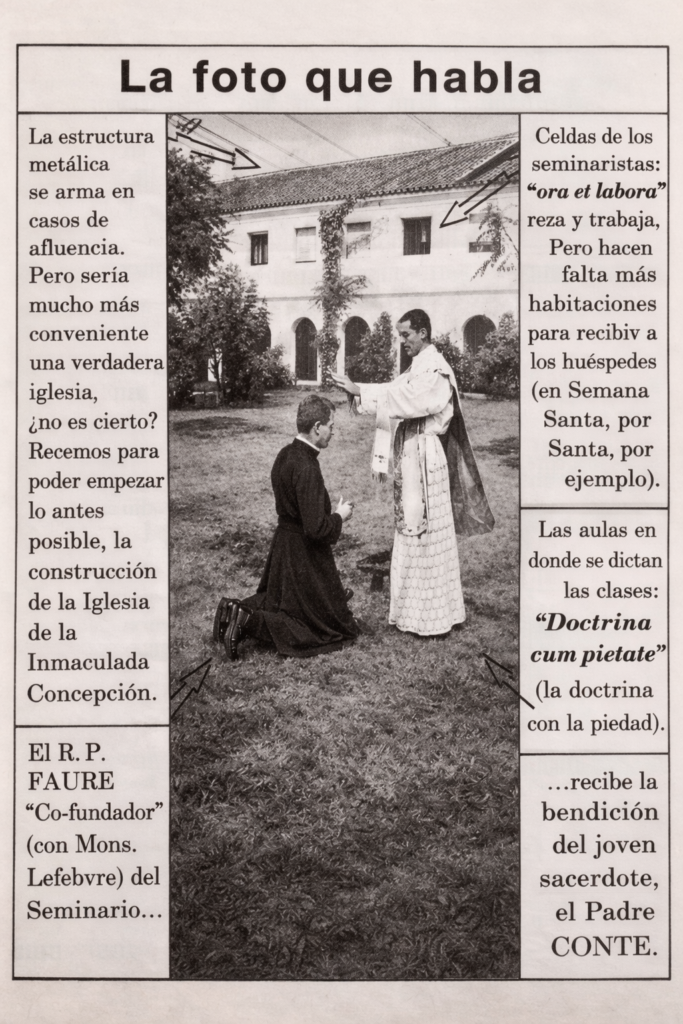
The photo that speaks
“The metal structure is erected in cases of large attendance. But would not a real church be much more suitable? Let us pray so that we may begin as soon as possible the construction of the Church of the Immaculate Conception..
Fr. Faure
‘Co-founder’ (with Mgr Lefebvre) of the Seminary…”
Cells of the seminarians:
“ora et labora” (pray and work).
But more rooms are still lacking to receive guests (during Holy Week, for example).
The rooms where the classes are given:
“Doctrina cum pietate” (doctrine with piety).
“…receives the blessing of the young priest, Father CONTE.”
THE ORIGIN OF THE NAME:
SOCIETY OF THE APOSTLES OF JESUS AND MARY (SAJM)
Mgr Faure was one of the historic members of the Priestly Fraternity of Saint Pius X, whose statutes — under the double title also of the Fraternity of the Apostles of Jesus and Mary — were approved on 1 November 1970 by Mgr François Charrière and officially praised on 18 February 1971 by the Sacred Congregation for the Clergy under Cardinal Wright. This double designation was juridically included in the very decree of erection of the work founded by Mgr Lefebvre.
By taking up again the expression Society of the Apostles of Jesus and Mary (S.A.J.M.), Mgr Faure did not introduce a new name, but reused a designation already present in the statutes approved in Fribourg. The use of the title therefore refers to the original historical formulation, as it was recognised by the competent authorities at the time and desired by Mgr Lefebvre in order to name his own Fraternity.
SAINT LOUIS-MARIE GRIGNION DE MONTFORT SEMINARY
SOCIETY BLOG

Monastery of the Holy Cross

Blog Non Possumus
Support a work of Tradition!
Mgr Marcel Lefebvre Seminary
CNPJ (PIX Key)
30.171.417/0001-88
The Priestly Society of the Apostles of Jesus and Mary (SAJM), founded on August 22, 2016 by Bishop Jean-Michel Faure, remains faithful to the work and struggle of Bishop Marcel Lefebvre, in fidelity to the Faith of all time. In the context of the current crisis in the Church, and continuing its formative mission, the SAJM has taken on responsibility for a seminary in Brazil - the Dom Marcel Lefebvre Seminary - aimed at the formation and protection of future priests along the same doctrinal and spiritual lines.
Contact us!
Site created by Imperium
Contact
Seminar, Estr. Alcino da Cunha Ferraz km 1 s/n, Janela das Andorinhas - Riograndina, Nova Friburgo - RJ, 28634-438
Morning: das 9h às 11h (Contato)
Afternoon: das 15h às 17h (Visitas)
Contact and WhatsApp:
+55 22 98800-8952
E-mail: seminariodomlefebvre@gmail.com
CNPJ (Brazilian register):
30.171.417/0001-88